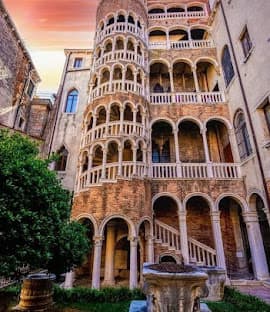
Among the narrow streets and quiet courtyards of Venice lies a structure that perfectly embodies the city’s creative spirit and architectural grandeur — the Scala Contarini del Bovolo. Known as the “staircase of the snail” for its striking spiral form, this 15th-century marvel is one of Venice’s most captivating hidden treasures.
Located in the San Marco district, not far from Campo Manin, the Scala Contarini del Bovolo elegantly combines Gothic arches with Renaissance geometry, creating a structure that feels both timeless and dreamlike. For those seeking a lesser-known yet profoundly Venetian experience, this architectural gem offers a journey through history and artistry, crowned with a panoramic view of Venice’s skyline.
Location and Access
The Scala Contarini del Bovolo is situated at San Marco, 4306, just a few steps from Campo Manin and about a five-minute walk from St. Mark’s Square. Hidden within a maze of narrow alleys, the staircase is a delightful surprise to anyone who stumbles upon it — a serene contrast to the bustling piazzas nearby.
Visitors can reach it easily from the Rialto Bridge or Accademia Gallery, both within a ten-minute walk. For those arriving by vaporetto, the closest stops are Sant’Angelo and Rialto, from where the attraction is just a short stroll through Venice’s charming backstreets.
Despite its central location, the Scala remains one of the city’s quieter landmarks, offering a tranquil escape for those who wish to experience Venice beyond its main tourist routes.
A Brief History of the Scala Contarini del Bovolo
The Scala Contarini del Bovolo was commissioned in the late 15th century by Pietro Contarini, a member of one of Venice’s most influential noble families. The word “bovolo” translates to “snail” in Venetian dialect, aptly describing the staircase’s spiral shape that winds upward like a shell.
The staircase was designed to adorn the Palazzo Contarini del Bovolo, the family’s residence, and to showcase their wealth, refinement, and architectural taste. The result was a structure that merged Venetian Gothic elegance with Renaissance innovation — a fusion that became a hallmark of late medieval Venice.
Its graceful spiral not only served a functional purpose but also symbolized prestige and power, a physical manifestation of the Contarini family’s social ascent. Over the centuries, the Scala became an emblem of beauty and proportion, admired by artists and scholars alike.
Architectural Significance
The Scala Contarini del Bovolo is a masterpiece of form and symmetry. Its most distinguishing feature is the exterior spiral staircase, which wraps around a cylindrical tower rising from a small courtyard. The staircase’s design — a series of elegant arches supported by slender columns — creates a stunning interplay of light and shadow throughout the day.
Architecturally, it represents a transitional style between the late Gothic and early Renaissance periods. The pointed arches of the loggias recall Venice’s Gothic palaces, while the precise geometric arrangement of the spiral reflects the emerging ideals of Renaissance humanism.
At the top of the staircase lies the belvedere, or viewing platform, offering sweeping vistas over the rooftops of Venice, including the domes of St. Mark’s Basilica and the Campanile. The ascent, though modest in height, rewards visitors with one of the most intimate and poetic panoramas in the city.
Restoration and Preservation
Over the centuries, the Scala Contarini del Bovolo suffered periods of neglect and decay. By the 19th century, it had fallen into disrepair, though its beauty still drew admiration from visitors and artists — including the renowned writer John Ruskin, who praised it in his works.
In the 20th century, restoration efforts began to preserve the staircase’s structure and decorative elements. The most recent and significant renovation was completed in 2016, when the Scala was reopened to the public after years of careful conservation.
Today, the site is maintained by the Istituto Provinciale per l’Infanzia Santa Maria della Pietà, ensuring that this architectural gem remains accessible to visitors while preserving its historical integrity.
Visiting the Scala Contarini del Bovolo
Visitors can explore both the exterior courtyard and the interior staircase, which ascends through several levels to the viewing terrace. Along the way, interpretive displays and photographs offer insights into the staircase’s history and construction.
Opening Hours: The Scala is generally open daily, with slightly shorter hours in the winter months. Morning and late afternoon visits are particularly rewarding, as the soft Venetian light enhances the building’s intricate details.
Tickets: Entrance is modestly priced, with discounts available for students and seniors. Ticket sales often include access to temporary art exhibitions held inside the adjoining Palazzo Contarini del Bovolo, where visitors can admire paintings, photographs, and sculptures inspired by Venice’s urban beauty.
The View from the Top
The climb to the top of the Scala Contarini del Bovolo is as captivating as the view itself. Each turn of the spiral reveals new perspectives on the palace courtyard and the rooftops beyond. When visitors finally reach the belvedere, they are greeted with one of Venice’s most evocative panoramas.
From here, the city unfolds in all directions — the Campanile di San Marco rises proudly to the east, while the Grand Canal glimmers between rooftops and bell towers. The Basilica della Salute and the Giudecca Island can also be glimpsed in the distance.
As the golden light of evening descends, the scene becomes almost painterly, evoking the romantic atmosphere that has inspired artists for centuries.
A Hidden Treasure in the Heart of Venice
While the Scala Contarini del Bovolo remains less visited than Venice’s larger monuments, it holds a special allure for those who seek authenticity and beauty beyond the usual tourist paths. Its quiet courtyard, delicate columns, and spiraling grace capture the poetic soul of the city — where art and architecture merge effortlessly with history.
Photographers, architecture enthusiasts, and romantics alike find the Scala an irresistible subject. Its blend of proportion, symmetry, and light embodies the essence of Venetian aesthetics: elegant, imaginative, and eternally graceful.
Tips for Visitors
Best time to visit: Early morning or late afternoon for soft lighting and fewer crowds.
Footwear: Comfortable shoes are recommended for the climb.
Photography: The spiral staircase and rooftop terrace are highly photogenic; a wide-angle lens captures its curves beautifully.
Nearby attractions: Combine a visit with nearby sites such as Teatro La Fenice, Palazzo Fortuny, or Campo Santo Stefano.
Conclusion
The Scala Contarini del Bovolo is more than just an architectural curiosity — it is a celebration of Venetian ingenuity and grace. Hidden within the labyrinth of San Marco, this exquisite spiral staircase tells a story of beauty, ambition, and the city’s timeless relationship with art and light.
For those who climb its elegant steps, the reward is not only a magnificent view but also a deeper connection to the Venice that thrives quietly behind its grand façades.