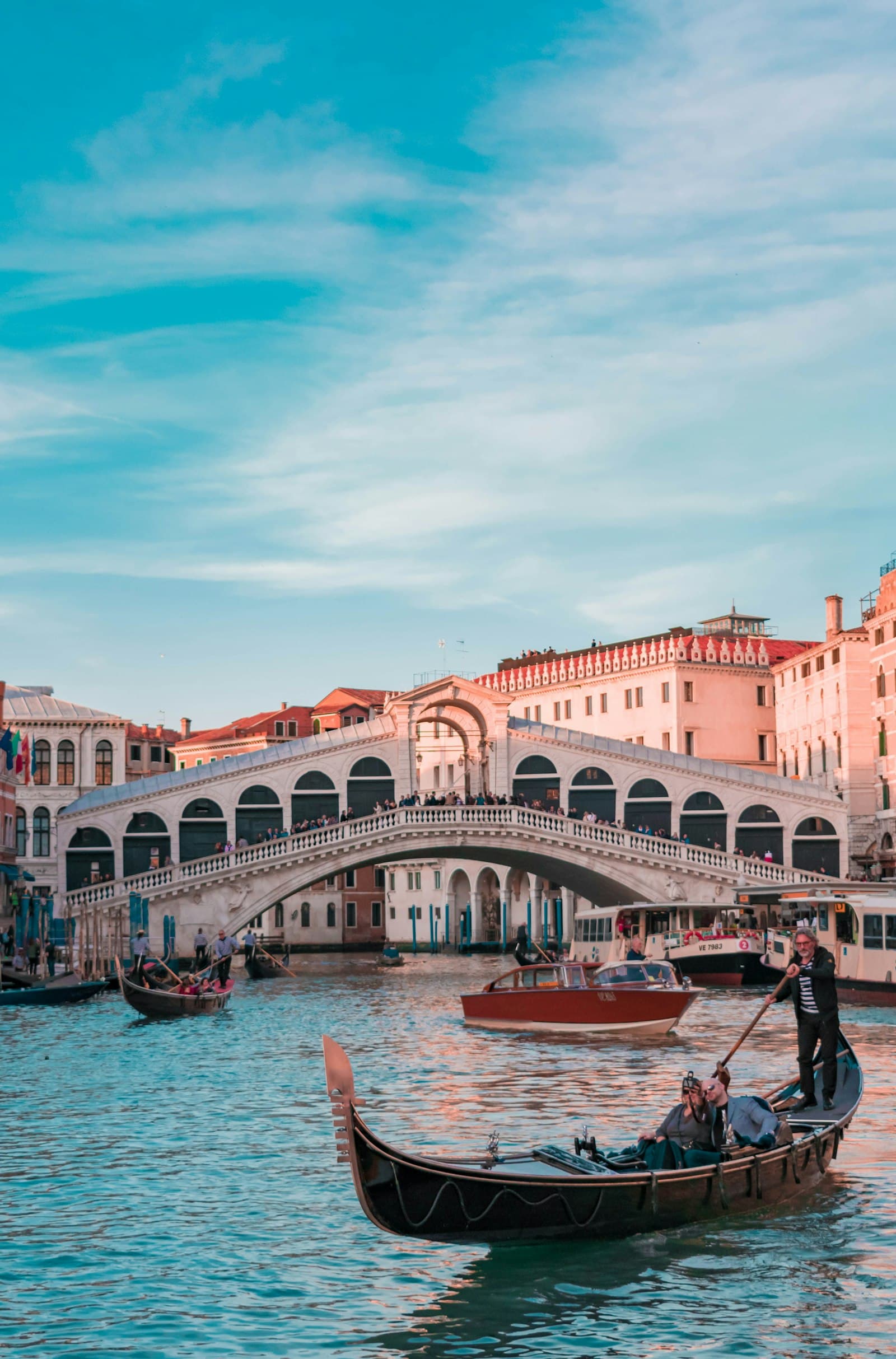
Almanac of Venice History
History of Venice, almanac of the history of Italy, the Venetian traditions, Food recipes, Culture, Geography and Venice guide map at VeniceXplorer.
The history of Venice is a saga of refugees, lagoon, doges, merchants, crusaders, artists, plagues, naval power, decline, renaissance, and survival. The short history of Venice traces the city’s story from the legend of its foundation in 421 AD to the heyday of the Republic and to present-day Venice, where the history remains alive in every church, bridge, island, palace, and celebration.
Venice did not spring into existence. From dispersed island settlements in the Venetian Lagoon, it slowly evolved into a great maritime power. This history covers the strategic defensiveness of the Venetian Lagoon, the growth and centrality of Rialto, the symbolism of St Mark’s Basilica, the structure of the Doge’s Palace, the muscle of The Arsenal of Venice, and the historical memory enshrined in Venetian Events like Carnival, the Regata Storica, the Festa del Redentore and Festa della Salute.
Earlier dates, especially the legendary 25 March 421 AD, should be viewed with caution; historians may still deem them traditional or apocryphal. Visit Venice Italy rightly remarks, "The origin date of Venice has not been archaeologically proven to be exactly March 25, 421 AD."
Experience Venice with a Dedicated Personal Concierge
Venice Before Venice: Ancient Venetia and the Lagoon
Venice, the city, may be young, but the broader area called Venetia has an ancient history. The northern Adriatic was home to various communities in pre-Roman times. The shallow, protective waters of the lagoon provided refuge during the unstable times that followed Roman power's decline.
Aquileia became one of the major Roman cities of the region. Venice's future region, Venetia, was incorporated into the Roman Empire by Octavian in 42BC.
The geography of the lagoon was integral to Venice's identity. The vast array of mudflats, marshes, islands, and channels meant that the lagoon was difficult for armies to penetrate but ideal for fishing, salt production, trade, and later maritime defense.
These factors led Venice to develop into a unique kind of city-not built on hills, river valleys, or Roman roads, but in the water, shaping all life around boats, tides and timber.
The Legendary Founding of Venice
According to tradition, on March 25, 421, Venice was officially founded with the establishment of a trading post at the Rialto islands and the building of a church in honor of San Giacomo. Images of Venice calls this the "legendary foundation of Venice" and frames it within the context of refuge and mainland instability.
After the fall of Roman power in the west (476 AD), the Venetian Lagoon saw an influx of refugees fleeing a range of groups including Goths, Huns, and Lombards. "In the years between 400-450," notes Visit Venice Italy, "people from the mainland took refuge in the Venetian Lagoon escaping from all the barbarian invasions."
This founding story is key to understanding the Venetian psyche. Venice was born not from settled citizenship, but from refuge. The ability to survive through trade, the water, community effort, and distance from the mainland forged a distinct, enduring identity.
Byzantine Venice and the Rise of the Doges
In its early stages, Venice was heavily influenced by the Byzantine Empire. From Ravenna, a key Byzantine center, early Venice’s government structure evolved. By the sixth and seventh centuries, settlements such as Heraclea (later called Cittanova), Torcello and Malamocco rose to prominence along with the central Rialto. Visit Venice Italy records the founding of Cittanova, “between 637 and 639," and "the church of Santa Maria Assunta in Torcello in about 639–40.”
During this early political structuring of the lagoons, the position of the Doge was created. Traditionally, the first Doge was Paoluccio Anafesto in 697 AD, but much of the early history of Venice and its first Doges is steeped in legend. Visit Venice Italy points out that the early doges "were quite different from their later counterparts and remained under the influence of Byzantine authorities."
This slow transition from dependence to local governance was an enduring theme in Venice's history and allowed it to chart its own independent course while maintaining strategic relationships with greater powers.
The Centrality of Rialto
By the beginning of the 9th century, the location of the Rialto had grown increasingly important to the development of the settlement in the lagoon. The island group was central, defensible, and, most importantly, located on the major waterways leading to the sea. When the king of Italy, Pepin, son of Charlemagne, tried to attack Venice in 810 AD, he found the terrain treacherous and his army eventually withdrew after a six-month siege, according to Images of Venice.
Doge Agnello Participazio established his residence on Rialto, marking the traditional beginnings of the Doge’s Palace as a physical site of power on the island. From this point forward, Rialto would become the commercial heart of Venice, eventually featuring the banks, bridges, trading houses, and market that would make the city the nexus of medieval trade in Europe.
Today, Rialto remains one of the best places to visit to see evidence of how trade shaped Venice.
The Arrival of Saint Mark and Venetian Identity
The relics of St Mark, transported from Alexandria to Venice in 828 AD, transformed the identity and aspirations of the city. St Mark became Venice's patron saint, and his symbols, particularly the winged lion, came to represent the power and prestige of the Venetian Republic. Images of Venice records this landmark event in 828, associating it with the "rise to prominence for the church and of the veneration of the cult of Saint Mark."
St Mark's Basilica, standing proudly adjacent to the Doge's Palace, became far more than a place of worship; it became a testament to the union of faith and state. Venice used St Mark to proclaim its destiny and independence, while the image of the winged lion began to appear everywhere from flags and coins to ships and buildings-a visual language of authority in the Adriatic and Mediterranean.
Venice Emerges as a Maritime Republic
Sea power was the engine of Venice's ascent. In the year 1000 AD, Doge Pietro II Orseolo sailed to Dalmatia with his fleet, quelling pirates and securing vital trade routes. Images of Venice calls this, "a significant event that established Venice as the dominant naval power in the Adriatic."
Further consolidating this power, Byzantine Emperor Alexios I Komnenos granted Venice significant trading concessions in 1082, which greatly benefited Venetian merchants in the eastern Mediterranean.
Meanwhile, The Arsenal of Venice, dating back to 1104 AD, evolved into a massive complex dedicated to shipbuilding. The ability to produce ships and fleets of unprecedented scale allowed Venice to maintain and expand its trade networks and exert its military might.
The Crusades and Venetian Mediterranean Empire
The Fourth Crusade proved to be a critical turning point in Venice's history, with far-reaching and controversial consequences. Venice, under the leadership of Doge Enrico Dandolo, became the primary transport provider for the crusaders.
However, the campaign was diverted through Zara before ultimately attacking and sacking Constantinople in 1204. Images of Venice reports that following this plunder, "Venice received considerable territorial gains and extensive commercial privileges," including "the horses of St. Mark."
This event catapulted Venice into the status of a Mediterranean empire. Venice would expand its influence across islands and trading ports, including the annexation of Crete in 1211. While bringing immense power and wealth to the city, this action also damaged relationships with the Byzantine Empire, creating long-term instability in the region.
Marco Polo and the Age of MerchantsVenice was a merchant republic, and there are few people who better embodied that image than Marco Polo. Marco Polo set out for Asia in 1271, and returned from Cathay in 1295. In 1298 he was taken prisoner during the Battle of Curzola, where it's believed that it was during his imprisonment that he told the account of his travels.
Images of Venice illustrate these major Marco Polo dates in relation to the broader chronology of the Republic.
In the late 13th century, financial history was made when Venice issued its first gold ducat in 1284. The ducat went on to become a widely accepted currency across Mediterranean trade, indicative of trust in Venetian commerce, banking, and political stability.
The Serrata and the Aristocratic RepublicThe government of Venice became known for its stability, its secrecy, and its aristocratic exclusivity. Established in the 12th century, the Great Council was closed to members not in certain families via the Serrata del Maggior Consiglio in 1297.
Wikipedia refers to the Serrata as having the effect of barring the lower classes from participation in the government and establishing a patrician led-aristocratic regime.
In the wake of the failed Tiepolo conspiracy of 1310, the Council of Ten was established, which would evolve into a body responsible for state security, surveillance and political discipline within the Republic. Though far from democratic by modern standards, Venetian government was organized, balanced and durable. Venice and Genoa: Rivalry for the SeasVenice and its great maritime rival, Genoa, competed for trade routes, colonies and control of commerce in the eastern Mediterranean.
This competition led to wars that continued for generations, climaxing during the War of Chioggia, from 1378 to 1381. According to Images of Venice, Venice defeated the Genoese fleet at Chioggia in 1380 and ended the war with the Peace of Turin in 1381. This victory didn't mean Venice was invincible, but it did demonstrate its ability to survive one of the greatest military challenges it faced.
Plague, Disaster and DevotionWhile wealth came to Venice through trade, it also came at the cost of exposure to devastating plagues.
Black Death arrived in Venice in 1348, killing a substantial proportion of the city's inhabitants. Later plagues left their mark on the city's churches and annual rituals. The plague of 1575–1577 prompted the votive church, Redentore on Giudecca. As noted on the San Marco Press website, Festa del Redentore is celebrated on the third weekend in July to commemorate the plague vow of 1576 and the promise to build a magnificent church to the Redeemer.
The plague of 1630–1631 inspired the Basilica di Santa Maria Della Salute.
Images of Venice record the devastation of 1630–1631 (around 50,000 dead) and Venice's building of Santa Maria Della Salute as a plea for deliverance from plague. Venice on the Mainland and Against the OttomansBy the 15th century, Venice had expanded beyond its lagoonal confines, and it created a mainland state, known as the Terraferma, annexing such cities as Vicenza, Verona, Padua, Brescia and Bergamo.
Images of Venice indicate Venetian annexations including Vicenza, Verona, Padua, and Este (1405); Brescia (1426) and Bergamo (1428).
Meanwhile, the Ottoman Empire grew into a formidable challenge. The fall of Constantinople in 1453 dramatically altered the balance of power, leading to several Ottoman-Venetian Wars during which Venice gradually lost territories in the east, though it managed to gain control of Cyprus in 1489 by Catherine Cornaro. However, Crete would fall after the Long Cretan War in 1669.
Images of Venice lists the fall of Constantinople, the cession of Cyprus to Venice and the loss of Crete as key events.
Renaissance Venice: Art, Printing, Music and Public Culture
Despite the increasing pressures on its political and economic power, Venice remained a dynamic centre of Renaissance culture. Its achievements included outstanding achievements in painting, printing, architecture, music, and public life.
Printers such as Aldus Manutius made Venice a European hub for books, while artists like Titian, Tintoretto and Veronese gained international fame for their paintings. Antonio Vivaldi was born in 1678 and became one of Venice’s most celebrated composers.
The Wikipedia timeline of Venice mentions the opening of the Teatro San Cassiano in 1637 and Vivaldi's birth.
The establishment of the Jewish Ghetto in Cannaregio, Venice, in 1516 was a significant landmark in the city's history. Images of Venice shows the 1516 Venetian Ghetto; the museum offers insights into the history of settlement, restriction, faith and community. The Long Decline and the Fall of the Republic Venice's decline was not a swift process.
Its influence gradually diminished as trade shifted to Atlantic routes, Ottoman power increased, and territorial losses mounted. The development of a maritime route to India by the Portuguese curtailed Venice's previous dominance in eastern trade. Images of Venice notes that Vasco da Gama’s arrival in India in 1498 had major implications for Venice's land-based dominance over eastern trade.
Napoleon provided the final act.
In 1797, the Republic fell. According to Wikipedia, the Republic of Venice was dissolved on May 12, 1797, bringing to an end some 1,100 years of history. The last Doge was Ludovico Manin, elected in 1789. San Marco Press also records March 9, 1789 as the date Ludovico Manin became the last Doge of Venice.
The collapse of the Republic remains a defining event in the history of Venice.
The Fall of the Republic did not, however, mark the end of the city's unique cultural identity. Venice Under Austria, Italy, and Modern EuropeAfter 1797, Venice passed through periods of French and Austrian rule before joining the Kingdom of Italy in 1866. Wikipedia's article on Venice specifies the city's incorporation into the Kingdom of Italy as part of the Third Italian War of Independence in 1866.
In the 20th century and beyond, Venice adapted, developing new cultural institutions and modern infrastructure such as the Venice International Film Festival, launched in 1932, and Ponte della Libert, which opened in 1933. Wikipedia also lists the 1966 acqua alta as a particularly severe high-tide event and the 1996 fire at La Fenice Theatre as significant. In the 21st century, Venice continues to contend with the pressures of tourism, the challenges posed by climate change, and the ongoing efforts to preserve its fragile ecosystem.
The 2019 acqua alta was recorded as the second highest, and the COVID-19 pandemic significantly curtailed tourism in 2020, causing the early cancellation of Carnival. In 2021, Venice celebrated the 1,600th anniversary of its traditional foundation.
Key People in Venice History
Venice's history is, at its heart, a human story. Paoluccio Anafesto is remembered as the city's traditional first Doge. Agnello Participazio is associated with the rise of Rialto and the early construction of the Doge's Palace.
Pietro II Orseolo laid the foundation for Venice's maritime dominance in the Adriatic.
Enrico Dandolo, famous for his role in the Fourth Crusade, was instrumental in expanding Venetian influence throughout the Mediterranean. Marco Polo represents Venice's merchant spirit. Pietro Gradenigo was responsible for the Serrata of 1297.
Marino Faliero is infamously known as the Doge who was executed for treason. Francesco Foscari oversaw significant expansion of Venice into the mainland. Catherine Cornaro brought the island of Cyprus into the Venetian realm.
Andrea Gritti played a crucial role in Venice's recovery after the League of Cambrai crisis.
Aldus Manutius made Venice a major center of printing and scholarship. Titian, Tintoretto, and Veronese made their marks on the city's artistic landscape. Antonio Vivaldi is a celebrated Venetian composer. Ludovico Manin was the Republic's final Doge.
History of Venice by Place
The most effective way to encounter Venice’s past is to link place and time. The story of trade, the life of the market, banking, and earliest settlement begins with the Rialto. Relics, religious devotion, and national identity unfold with the history of St. Mark’s Basilica.
The story of law, ceremony, and political power resides in the history of Doge’s palace.
Naval production and maritime power are woven into the history of The Arsenal of Venice. Jewish life and controlled cosmopolitanism live in the history of Cannaregio Venice and the Ghetto. The story of glass and crafts can be experienced with Murano and its Glass Museum. The lagoon island history of Murano and Burano Island Venice’s lace tradition contribute their distinctive cultural identities. Torcello provides a quieter, earlier Venetian memory of the lagoon.
The Venice Lido and its modern history as a center for leisure and its famous film festival also hold Venetian stories. Giudecca and the churches associated with it such as Redentore Church and Basilica di Santa Maria Della Salute carry the story of public vows against the plague.
Best Venice Gondola Rides
Visitor Information
Opening Hours: The Almanac of Venice History: Key Events, People & Timeline does not correspond to a single ticketed attraction. It should be viewed as a historical route throughout the city, connecting the most significant historical sites. You are free to wander through public areas such as Rialto, St Mark's Square, and the Grand Canal viewpoints.
However, if you wish to enter museums, palaces, churches, and the Arsenal of Venice, you will need to purchase individual tickets and check the operating hours for each venue, as these vary considerably.
Many historic sites in Venice are individually managed. For example, while St. Mark's Basilica is a prominent landmark, its entry, like that of the Doge's Palace or other major attractions, is subject to specific ticket and visiting hours, which are published on the official websites of each institution.
The historic journey outlined in this timeline is best experienced by planning your visits to the interiors and collections of the listed attractions, keeping in mind their separate opening times and entry requirements.
Best Time to Visit: A visit to Venice for history must take place at a time when the events on the city's calendar naturally coincide with those in its past. Visit in late March for the Feast of the Annunciation, which corresponds to the legend of Venice's founding on March 25 in 421 (the feast and foundation date is confirmed by San Marco Press).
Alternatively, plan your history trip to Venice for the third weekend of July to experience the Festa del Redentore, which marks an 1576 plague and a promise made to build the church of Christ the Redeemer on the Giudecca.
If your visit coincides with the Venice Biennale, beginning in 1895, or the Venice Film Festival (1932), you'll also experience a blend of past and present in the cultural history of the city, according to San Marco Press and Wikipedia respectively.
During the late autumn, you will also witness some major acqua alta events which form part of Venice's recent history according to Wikipedia.
Dress Code and Entry Rules: A Venice history trip requires sensible outdoor wear. Be prepared to walk and use public transportation; wear comfortable shoes, suitable clothes for being outdoors, on bridges, in squares, canals, and enjoying views of the lagoon.
Churches and sacred sites in the timeline should be treated with appropriate reverence, including St Mark's Basilica, Santa Maria della Salute, Redentore, and the early church heritage on Torcello.
There are no general entry restrictions and guidelines apply to each site separately as they consist of public spaces, churches, theaters, civic monuments and heritage buildings which operate on their own systems and ticketing procedures.
The suggested sources do not contain current entry rules and other regulations for the specific historic sites on this timeline, so you should verify that before your visit on the website of each respective institution.
Ticket Information
There is no unified Venice history tour ticket for the Almanaque de la historia de Venecia as it does not represent any specific monument, theatre or museum, but the entire history of the city.
Henceforth the suggested route would be a combined one that integrates the history of free public spaces (Rialto, views of the lagoon, the outer walls of the Arsenal, Cannaregio, Giudecca etc.) with the historic spaces that are individually ticketed (the museums, the interiors of the churches, the palaces, theatres and certain exhibitions).
You can ascertain the historic significance of many of these sites through sources like Images of Venice, who documents the legendary origin of Rialto, the arrival of the relics of St. Mark in 828, the growth of the Doge's Palace, beginning from the Rialto dwelling of Agnello Participazio, and the genesis of the Arsenal in 1104.
In addition to the origin story, Wikipedia's timeline also covers some of Venice's later cultural and historical moments, including the Venice Biennale and Film Festivals and, more recently, the 2019acquaaltaand the 1966 flood.
Online Booking: Your tickets must be bought for the specific museums, theatres, or historical monuments that make up your Venice itinerary and not for the Almanaque.
The suggested sources do not provide information for the official online reservation of a comprehensive Venice history trip itinerary. You must book directly with the websites for each attraction (museum, church, theatre, monument) you wish to visit. Book strategically according to the article's timeline.
It is recommended to visit in the chronological order established (early Venice and St Mark, the Republic, the naval power, the plague churches, Jewish history, art and music, contemporary Venice) to gain a holistic perspective rather than purchasing individual tickets at random.
Guided Tours: Guided Tours for this trip to Venice is an essential experience to enhance the understanding of its history as, without help from a guide, the history that is encapsulated within these sites would be impossible to decipher solely based on the physical space.
A guide can explain how Rialto was crucial to the earliest trade, the arrival of the relic of St. Mark at St Mark’s Basilica, the political power of the Republic at the Doge’s Palace, the naval capacity of Venice at the Arsenal, the history of Venice's Jewish heritage in the Cannaregio, the consequences of plague in Giudecca or at the church of the Redentore, and much more.
A walk chronologically tracing the history of Venice would be the ultimate tour: begin at Rialto, progress toward St Mark's and the Doge's Palace, expand outwards toward the Arsenal, then delve into Cannaregio, Dorsoduro, Giudecca, and the islands depending on the time you have to dedicate to this incredible journey.
This itinerary is perfectly aligned with the temporal arrangement of the historical sources: a trip that goes from the mythical foundation of the city, through Byzantine and the maritime republic times to the fall of Venice and to the cultural present of the city.
Our Recommended Tickets
Murano and Burano with Visit to the Glassworks and Lace Museum
Half Day Murano and Burano Island Tour by Private Boat
Venice : Private Boat Tour of the Venice Lagoon
A Venetian Almanac: Historic Dates by Month
The historical timeline of Venice can gain a sense of rhythm through an almanac approach. March 25 is still a celebration of the traditional founding day and the Feast of the Annunciation. The website for the historic books publisher San Marco Press notes “25 March is traditionally taken as the date on which the foundation of the Republic took place in 421.”
On June 15, the Festa di San Vio remembers the abortive 1310 coup attempt, which San Marco Press describes as a remembrance “for that failed bid for power to overthrow the Republic.”
The third weekend of July offers the Festa del Redentore, commemorating the vows of public penance from the 1576 plague. November 21 honors the Feast of the Salute, in thanksgiving for the end of the plague that ravaged the city between 1630 and 1631 with the church by Baldassare Longhena, Basilica di Santa Maria Della Salute, the primary commemoration site.
The December 6th Feast of San Nicol can serve as an entry point into the social and political life of the city, as that day is remembered through its churches and social organizations. These events preserve civic memory and religious piety.
A Venice Timeline: Key Moments
- 302 BC: Spartan attack on the lagoon defeated
- 181 BC: Foundation of Aquileia
- 25 March 421: traditional founding of Venice
- 568 AD: Lombard invasion of mainland Italy leads to settlement in the lagoon
- 697:Traditional date for the first Doge
- 810–812: Venice successfully resists Pepin and its importance grows at Rialto
- 828: Saint Mark’s relics brought to Venice from Alexandria
- 1000: Venice becomes a dominant power in the Adriatic
- 1082: Byzantine trading privileges grant Venice advantages
- 1104: Beginning of the Arsenal of Venice
- 1204: Venice sacks Constantinople
- 1271: Marco Polo departs for the East
- 1284: First gold ducat coined
- 1297: The Serrata effectively closes the Great Council to all but established families
- 1348: Black Death arrives in Venice
- 1381: War of Chioggia concludes with a Venetian victory
- 1405: Venetian expansion to the Terraferma strengthens control over mainland territory
- 1453: Constantinople falls to the Ottoman Turks, marking a shift in Mediterranean power
- 1516: Establishment of the Jewish Ghetto
- 1575–1577: Plague and vow of Redentore
- 1630–1631: Plague and vow of Salute
- 1797: Fall of the Venetian Republic to Napoleon
- 1866: Venice incorporated into the Kingdom of Italy
- 1895: Venice Biennale starts
- 1932: Venice International Film Festival starts
- 1966: Major acqua alta (high tide) flood devastates the city
- 1996: La Fenice Theatre destroyed by fire
- 2019: Historic flood occurs in Venice
- 2021: Venice celebrates 1600th anniversary of its founding
Why History Still Matters in Venice
A visit to Venice is invariably a historical experience. The routes taken by visitors trace the same routes that served as conduits of commerce, religion, government, and ceremony for centuries. One walks across the Rialto today to take in the atmosphere of a district once the very pulse of commercial and fiscal life. Doge’s palace remains a focus of admiration as the heart of state authority.
St. Mark’s Basilica, a place of faith and identity, rises above the square. Crossing the lagoon to islands like Murano, Burano, and Torcello leads to encounters with distinct chapters of Venetian life.
Even modern problems –acqua alta, the future of the lagoon, the pressure of tourism, and the city’s role as a global symbol – are deeply rooted in the unique, watery relationship that made Venice in the first place.
Venice History in Brief: Venice from the Lagoon to the Republic and Beyond
Venice is a city shaped by its lagoon setting and its journey from a settlement of refugees fleeing the mainland barbarians in the sixth century, to a trading maritime republic of extraordinary wealth and influence, and then to a vibrant centre of art, music, and intellectual life.
The story of Venice is one of shrewd diplomacy, resilient military power, ingenious engineering to tame the lagoon waters, and a profound ability to assimilate and adapt influences from the East.
The rise and fall of the Venetian Republic offers a rich narrative of how a small island community evolved into a major world power and later experienced a slow decline before its final demise under Napoleon.
Best Venice Tours and Tickets
Conclusion
Venice’s history is far more than a collection of dates and monuments. It is the saga of how an unlikely city rose to prominence, forging a distinct civilization on water, influencing the course of European history, and continuing to inspire with its unique beauty and enduring spirit.
A visitor should read each building not as an isolated structure but as a testament to a specific time and purpose.
St.Mark’s Basilica stands for religious fervour and state identity; Doge’s palace embodies governmental power and public life; the Rialto bridge and the fish market are markers of trade and economic vitality; The Arsenal of Venice reflects maritime might; and Cannaregio’s Jewish Ghetto stands as a testament to religious and ethnic history and controlled cultural integration.
Other sites such as Basilica di Santa Maria Della Salute and Redentore Church bear witness to periods of crisis and communal devotion, while the islands of Murano, Burano, and Torcello provide a glimpse of life on the lagoon’s periphery. Taken together, these sites reveal Venice as a multilayered entity, a city where beauty is inextricably bound to memory.