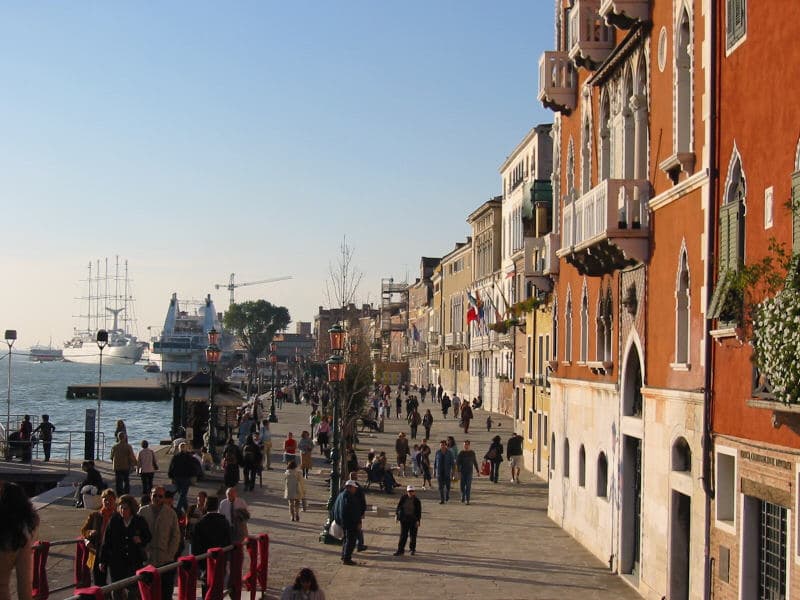
Zattere in Venice: the quick guide
The Zattere is a waterfront promenade on the southern edge of Dorsoduro, facing the Giudecca Canal. Come for an unhurried walk, views across the water and a gelato stop, with churches and art museums nearby. The promenade is a public street: there is no entrance ticket or museum-style opening time.
Unlike the narrow routes around St Mark's Square and St Mark's Basilica, this broad waterfront gives you space to enjoy the light and passing boats. Water-bus stops, deliveries and café terraces make it a working waterfront as well as a place for a stroll.
| Planning question | Quick answer |
|---|---|
| Where is it? | Dorsoduro, on the north bank of the Giudecca Canal, opposite Giudecca island. |
| How far does the walk go? | From the San Basilio end along the waterfront towards Punta della Dogana. |
| How long should I allow? | Set aside about an hour for a relaxed walk and a short stop; add time separately for museums or a meal. |
| What does it cost? | The promenade is free. Boats, food and paid attractions are separate. |
Where to find the Zattere and how to get there
On a map of Venice, look south of the Accademia Bridge for the long waterfront facing Giudecca island. The Zattere is the shore, not the name of the canal. Its western end is near San Basilio; the eastern walk passes the old salt warehouses towards Punta della Dogana and the entrance to St Mark's Basin.
On foot from Accademia
From the Dorsoduro side of the Accademia Bridge, follow Rio Terà Antonio Foscarini south to the waterfront beside the Gesuati church. The wooden bridge also gives views along the Grand Canal and stands beside the Gallerie dell’Accademia. This is a straightforward way to join the middle of the promenade. From Campo Santa Margherita or Ca' Rezzonico, walk through Dorsoduro towards San Trovaso and the Giudecca Canal; choose your route according to which part of the waterfront you want to reach.
By vaporetto
Zattere is the central water-bus stop for the promenade. San Basilio and Spirito Santo are other waterfront stops, useful for different ends of the area. They are not interchangeable platforms: check the stop, direction and departure for your journey. ACTV Line 2 serves Zattere and provides connections across the Giudecca Canal. Our vaporetto lines guide covers routes and onward travel. ACTV tickets can be bought online through Venezia Unica or in the AVM Venezia Official App; validate your ticket at the stop's reader at the start of each journey.
There is no permanent pedestrian bridge from the Zattere to Giudecca. Plan a boat journey if you want to cross. Leave extra time for boarding, and use the signs at the actual landing rather than relying only on a map pin.
A simple Zattere walk
- Start near San Basilio. Walk east along the waterfront, looking across the canal towards Giudecca. Watch the changing façades and passing vaporetti; pause where you can keep clear of boarding areas and delivery routes.
- Make a short detour to San Trovaso. The squero is a working boatyard associated with traditional gondola building and repair. View it from public space across the canal. The boatyard publishes a contact address for enquiries, not a visitor-admission schedule: contact it before planning an inside visit and keep its working area clear.
- Stop around the Gesuati. See the churches of Santa Maria della Visitazione and Santa Maria del Rosario, known as the Gesuati. They are separate neighbouring churches: the Visitazione belonged to the former religious complex, while the Gesuati, built in 1726–1735 to a design by Giorgio Massari, has a classical exterior and richly decorated Rococo interior. Its ceiling frescoes by Giambattista Tiepolo are a reason to step inside during visiting hours.
- Continue past Spirito Santo and the salt warehouses. This stretch leads towards Punta della Dogana. The warehouses recall the waterfront's trading history; any exhibition inside has its own opening arrangements.
- Finish at the tip of Dorsoduro, by Punta della Dogana. Enjoy the outlook over St Mark's Basin, then choose a museum, a return walk or a boat connection. Add only one major indoor visit if you want the outing to stay leisurely.
Photography, sketching, journaling and a coffee stop all suit the walk. Late-afternoon light can be attractive, particularly towards sunset; weather and season determine the view. For a seat, use a public bench where available or a café table when you are a customer, and keep bridges and church entrances clear.
Tip: If you arrive at Zattere from Accademia, turn west first for San Trovaso and Nico, then return east towards Punta della Dogana. This lets you see both sides of the central landing.
Gelato, cafés and food stops
Gelateria Nico, at Zattere 922, has made gelato on the waterfront since 1937 and is known for its gianduiotto: a slice of gianduia ice cream in a glass with whipped cream. Checked on 9 November 2026: its website lists winter hours of 7:00–20:00 (from 7:30 on Sundays), closed on Thursdays, and later closing in summer. Its waterfront terrace makes a natural pause on the walk; check the menu before ordering.
Ristorante Riviera, at Zattere 1473 on the western stretch, is an option for a sit-down waterfront meal. Its current menu combines Venetian dishes such as baccalà mantecato and tris in saor with seafood pasta and risotto. Opening days differ between listings, so check the restaurant’s current menu and reserve directly for your date.
For cicchetti, walk a short way inland to Cantine del Vino già Schiavi at Fondamenta Nani 992, near San Trovaso. This historic wine bar prepares cicchetti fresh every day and serves wine by the glass; there are no seats, so you eat and drink standing. Checked on 9 November 2026: it lists opening hours of Monday–Saturday, 8:30–20:30, closed on Sundays. The waterfront has further cafés and restaurants, and the streets inland offer more choices; compare prices and opening days before settling on a meal. Our Venice cafés guide can help with other stops. For Venetian flavours, look for sarde in saor, cuttlefish-ink risotto or cicchetti on a venue's current menu.
Churches, museums and nearby detours
The Zattere works well as the outdoor part of a Dorsoduro art day. Keep opening hours and admission separate from the free walk; churches may restrict visits for worship, and museums may close between exhibitions.
- Gesuati and Santa Maria della Visitazione: enjoy their waterfront façades. Checked on 9 November 2026: Chorus, the church network that includes the Gesuati, lists free entry to its churches, with fees only for some separate spaces; collect the free entry at the church ticket desk. The Gesuati's artistic visits run Monday–Saturday, 10:30–17:00, with last admission ten minutes before closing, and Chorus churches close to visitors on 1 January, Easter, 15 August and Christmas Day; worship has a separate timetable. The Visitazione belongs to the Don Orione Artigianelli cultural centre, and we found no regular public visiting schedule, so plan to see it from outside. Cover shoulders and knees for a church visit.
- Peggy Guggenheim Collection: a detour to Palazzo Venier dei Leoni on the Grand Canal for 20th-century art and the sculpture garden. Its collection includes Picasso, Pollock, Mondrian and Salvador Dalí; individual works are not always on view. Checked on 9 November 2026: the museum opens daily 10:00–18:00 except Tuesdays and 25 December, and standard adult admission is €17.
- Punta della Dogana: contemporary exhibitions from the Pinault Collection in the former customs house at the eastern end. Checked on 9 November 2026: it opens during exhibition periods only, daily except Tuesdays and 25 December, 10:00–18:00, so check the exhibition dates before you go.
- Gallerie dell'Accademia: one of Venice's leading art galleries, beside the Accademia Bridge on the Grand Canal. Checked on 9 November 2026: it opens Tuesday–Sunday, 9:00–19:00 (ticket sales end at 18:00), and a full-price ticket costs €15; check its calendar for holiday closures.
- Ca' Rezzonico: a palace on the Grand Canal that explores 18th-century Venice through paintings, frescoed rooms and historic furnishings, including works associated with Tiepolo and Longhi. Its grand ballroom is a highlight of the building. Checked on 9 November 2026: the museum opens 10:00–17:00 in winter (last admission 16:00), closed on Tuesdays, and a full-price ticket costs €15. Restoration scaffolding in the ballroom hides the walls and ceiling fresco, although you can still walk through and the other rooms are open as usual. Check its calendar for holiday closures.
- Campo Santa Margherita: an inland detour for neighbourhood cafés, shops, market activity and the student life of a large local square. Our Dorsoduro attractions guide covers the wider district.
Compare the inclusions of any pass against your chosen Venice museums and galleries. The MUVE Museum Pass includes Ca' Rezzonico, but does not include the Peggy Guggenheim Collection or Gallerie dell'Accademia. A transport pass is also a separate purchase. Book popular museum visits ahead when required and allow time for admission checks.
Across the water
Giudecca is a separate boat outing, with the Redentore Church, designed by Andrea Palladio, and views back towards Venice. Checked on 9 November 2026: Chorus lists the Redentore's artistic visits as Monday–Saturday, 10:30–17:00, with free entry to the church and €3.50 for its monumental sacristy. Explore its artisan workshops and gardens where public access is offered; private gardens need their own visiting arrangements. Use our Giudecca and San Giorgio Maggiore itinerary for the wider route.
San Giorgio Maggiore is on another island. Its Palladian church, with its white façade and richly furnished interior, gives art and architecture lovers a reason to make the crossing. The waterfront offers a different perspective on St Mark's Square, the Doge's Palace and the Venetian Lagoon. Checked on 9 November 2026: the abbey lists the basilica as open daily 9:00–18:00 and reports that its bell tower is temporarily closed for extraordinary maintenance. Check the abbey's visitor information before planning a tower visit.
Practical tips and the story behind the name
- Sun and weather: the waterfront faces south and can feel exposed. Bring water, sun protection in warm weather and an extra layer when it is windy. Spring and autumn can be pleasant, but no season guarantees empty streets or dry weather.
- Walking and access: wear comfortable shoes. If you have limited mobility, check bridges on your approach and along the waterfront, tides and boat boarding when planning an accessible route.
- By the water: keep children close and watch your footing near the edge. Leave space for residents, workers and people using the landings.
- Evening plans: public access to the street does not mean cafés, churches or boats run at every hour. Check your return journey and the particular venue's schedule.
- Events: use a dated programme for exhibitions or concerts rather than expecting an event on every visit.
The Italian word zattere means “rafts”. Timber from the mountain forests of the Veneto was floated down the rivers as rafts and landed along this shore. Venetian historian Giuseppe Tassini records a decree of 8 February 1519, in the Venetian calendar, to build the quay from Santa Marta to the sea customs house, and a later rule that timber had to be unloaded at the Spirito Santo bank. Coal and salt arrived here too. The Magazzini del Sale, built in the early 1400s and restored around 1830, stored salt, which Venice produced in its lagoon and also imported from across the Mediterranean. Today the old landing shore is one of the city's favourite sunny walks. Look for Palazzo Molin, later the headquarters of the Adriatica shipping company, among waterfront buildings from several periods. Our short history of Venice gives the wider background.
For help planning a Zattere visit as part of a longer stay, contact the VeniceXplorer personal concierge. If you want a separate organised outing, browse VeniceXplorer tours and tickets, including St Mark's Square experiences and Venice boat tours; check each product's route, meeting point and inclusions.
Our recommended tickets